Think of your body as a container. Through your nervous system, cells, bones and muscles, the body holds your stories, experiences and feelings. We literally have something called “cellular memory”. Our bodies can reflect different emotional, mental and nervous system arousal states.
At times, my body can feel tight, tense and rigid. It can develop chronic aches, pains, and lack energy. My breath can move in shallow formation. Thoughts will spin out as my brain recycles old stories or anticipates events that have never happened.
On the flip side, my body has also expressed calm, peace and spaciousness. I’ve experienced flexibility, strength and groundedness. My mind has felt clarity and focus. My breath has moved with ease, flow and softness.
Within the container of our skin, our body is a whole universe.
Talking about our problems, relationship conflicts and stuckness in life is incredibly important. We want to externalize what feels hard, depleting, scary, or uncertain. But the work for repair or healing doesn’t only happen in our cognitive brains.
Along with the verbal exploration of mood, conflict and life stuff, we must also attend to how the body expresses the words we speak or don’t speak. Often, clients can sit on the couch and speak for hours but not address the expression happening in their bodies. The words release but the embodied stuckness remains.
The Universe Beneath Your Skin
In the office, clients will learn somatic practices to help them realize that their body is in the room along with their thinking brains. We become aware of posturing, breath, how the feet might rest on the floor, where tension and space exist between the fingers and toes, joints, and muscles, quality of the voice and eye contact. We practice self-soothing techniques.
Clients will often become aware of sensations, pleasant or unpleasant, and connect those to the stories they share with me. We call this a “felt sense” experience, noticing how the quality of their pain or joy is felt in the body.
We work with the autonomic nervous system (ANS) to notice how a client may connect or disconnect from memories, experiences, or their partner in the therapy room. We find ways to use the body and breath to ground, establish boundaries, notice intuition, or feel safe.
Connecting the body’s felt sense to stories and experiences creates whole body awareness that allows for more complete processing, integration and healing.
Then Why the Dance Floor?
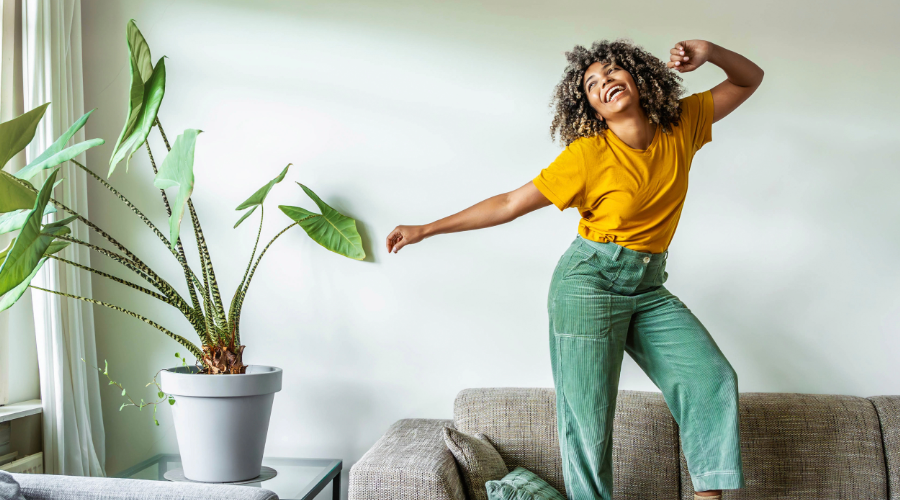
The dance floor welcomes you to find movement in stuck places. The open floor becomes a blank canvas, inviting you to show up as you are and also to try on new ways of moving through the world.
In the expanded space of a dance floor, with a wide range of rhythms, beats and music, conscious dance helps you lose yourself so that you can find yourself again. It will always meet you right where you are while inviting you to play with new shapes, forms, steps, beats and breaths.
Movement on a dance floor reminds us all that we are fully embodied humans in the here and now. Through movement, you get a clear sense of yourself.

What You Might Discover or Recover
The dance itself will reveal to you what you need to know. One any given day, you might discover that you feel in flow, or not flowing at all; light and playful, or perhaps overwhelmed; maybe you feel sharp and focused or can’t find a sense of direction; you might feel out of step one day or restless with unease; and another day, you might feel like you can fly across the dance floor, strong, like an eagle.
Whatever movement you have on any given day – that is your dance. Can you explore and breathe through that?
A-ha moments might include answers to some of the following:
- What happens when I begin to move? Or slow down? Or speed up?
- How do I express or censor myself when I move?
- How much space do I allow myself to take up?
- Do I travel or stay put?
- What part of the body feels the easiest to move, where do I lack movement?
- How do I move when I’m not given direction?
- Where do my thoughts go?
- Do my thoughts lead me? Or does my body lead me?
- What happens to me around the other bodies?
- Do I move toward others? Away? Against? Constrict? Expand? Shrink back? Join?
- What happens to my breath in these moments? My throat?
- Where do my eyes go? What do I choose to look at when I dance?
- What happens to me when someone makes eye contact?
- Am I aware of the boundaries of my skin? Of my personal space?
- How do I keep myself safe?
- How do I communicate with my body?
- How does any of this mirror how I move through the world?
- At what point do I drop in far enough, let all of the questions go and just dance?
How does conscious dance connect to relationships and sex?
As you can see from some of the questions above, sharing a dance floor with others can be both an individual and relational experience. Conscious dance is a playful way to discover yourself deeply, to ignite energy and passion, to become more embodied and attuned to others.
Through conscious dance, you get to explore how you move through space and how you feel when dancing alone or when you make contact with someone else. What happens in the body when it becomes more relational?
Experiencing pleasure in dance or in sex requires a deeply embodied state. Each requires present-centered awareness, playfulness, trust, empowerment, agency, passionate self-expression, vulnerability, clear boundaries and a willingness to explore.
Conscious dance is a wonderful way to raise your energy or vibration. It can help you discover what your body needs, how to honor your truth with others, communicate without words or express passionate embodied energy. It can help you find agency.

What are the benefits of conscious dance?
Movement with music offers so many physical and mental health benefits. These may include:
- Stress relief and relaxation
- Decrease in anxiety and depressive symptoms
- Flexibility, endurance and mobility
- Increased confidence and sense of agency
- Self-discovery, clarity and self-expression
- Present-centered awareness
- Increased trust in yourself
- Authentic social connection
- Greater access to freedom and joy
My personal Connection to Dance
Dance has served as a pathway back to joy for me ever since I was a kid. I spent many years on the dance floor while in elementary school and high school. Not only that but I’m someone who, upon hearing music, immediately starts bopping to a beat. I also can be deeply moved by a meaningful acoustic set. Connecting to the rhythm of music settles my nervous system, elevates my mood and soothes my soul.
Dance helps me improve my relationship with myself. As a body-centered practice, my body forms a connection to the rhythm, sounds, lyrics and beats of a song. Whether in movement or in stillness, my body resonates with the music and responds accordingly.
For me, conscious dance is much more than exercise. It’s a pathway to my home base, to my body, my deepest sense of self, where I can experience myself fully through movement. The more connected I feel with myself, the greater my capacity to connect with others.